
What’s going on in the Bozeman Rental Market?
Here at Headwaters, we spend a lot of time learning about housing affordability and the Bozeman housing market. Here’s our read on the big questions surrounding Bozeman housing.
After years of annual price hikes being the norm for renters in the Gallatin Valley, things seem to have taken a turn. Prices have stabilized and are down from pandemic era highs – good news! But there’s more to be done, as these stabilized prices remain out of reach for many residents, and we are likely to enter another era of increasing prices eventually.
How did we get here? Why are prices doing what they’re doing? And what can we do to sustain a more affordable and predictable housing market? Let’s dig in.
Where are we now?
Stabilized prices
According to the Montana Free Press, more than 3000 rental homes have come onto the market since 2021, with more than 1000 of those units completed in 2024. This flood of new homes onto the market has caused some prices to decrease, as property owners compete for tenants. SterlingCRE, a commercial real estate firm, reported at the end of 2025 that average multifamily home rents were down more than 3% from the year prior.
In individual cases, rent decreases have been even more pronounced: a leasing agent for the Oxbow Apartments in Bozeman told the Montana Free Press in June of 2025 that rents had fallen more than $400 for one-bedroom apartments. We are also seeing some price corrections in older housing stock as they compete against the newer housing.
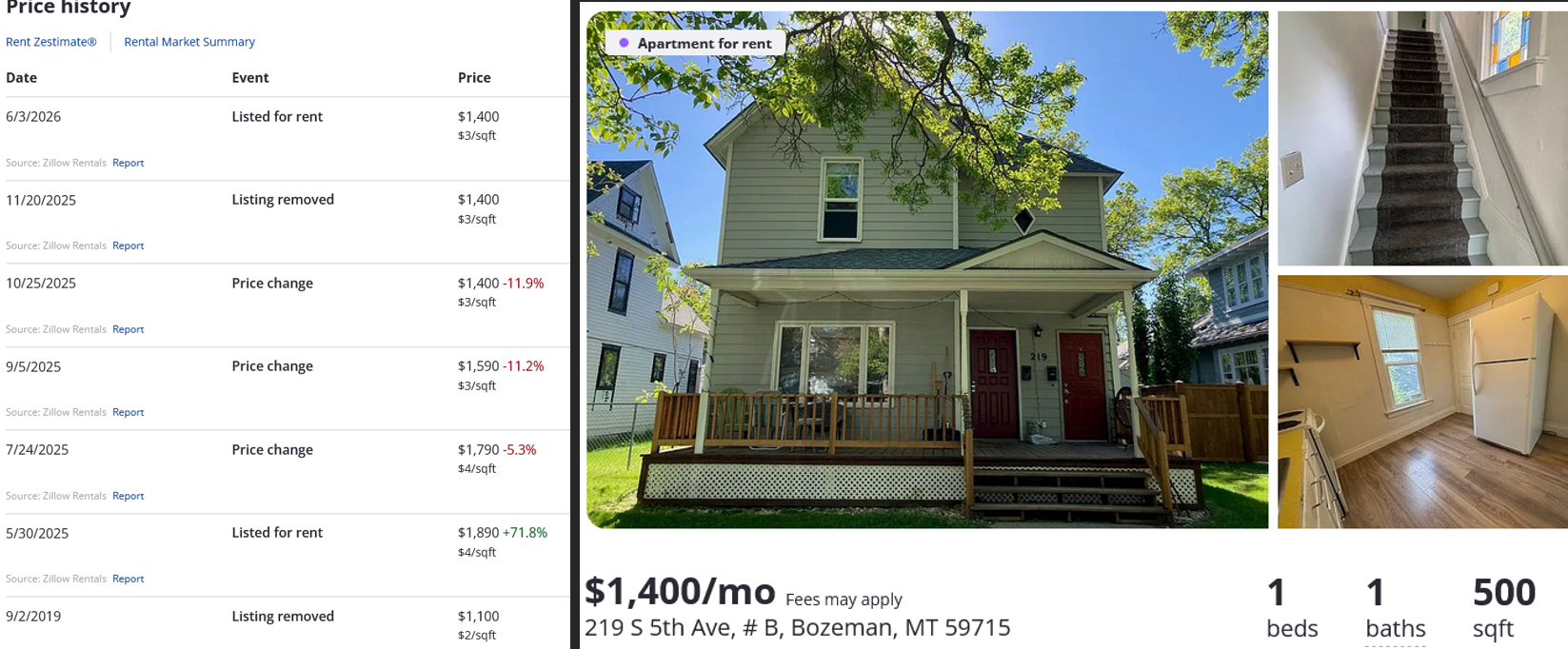
In a community as desirable as Bozeman, and within the context of a national economy that continues to see prices rising across essential expenses, the importance of even a slight decline in rents should not be understated. According to the U.S. Government Accountability Office, every $100 increase in median rent correlates with a 9% increase in homelessness.
Stable doesn’t mean affordable
The new housing stock has created a lot of options for middle income renters, but there are still gaps at the lower end of the affordability ladder.
Right now, there are more than 600 homes currently listed between $1800 and $2800 per month, giving renters at this income level the leverage to exact concessions from property managers. Unsurprisingly, there are fewer options further down the affordability spectrum, with 104 listings between $1400 and $1800, and less than 30 under $1400.
Still, addressing these gaps is critical. According to the 2026 Gallatin Valley Housing Report, 47% of renters are cost burdened, paying more than 30% of their income on rent. Furthermore, there are 6 households in need for every 1 rental assisted or cost restricted unit. Finally, non-family multi-person households have seen a dramatic increase, suggesting that many are “doubling up” to afford rent.
So, at a high level – yes, rents are down from pandemic era highs. Middle-income renters have lots of options in this market, but moderate and lower-income households are continuing to struggle to afford housing.
High Cost of Building
The cost of building new homes in the Gallatin Valley has increased sharply in the past few years as the price of land, labor, and loans have hit record highs. Even in projects with no profit margin built in, the development cost of new housing is greater than the prices that most households can afford.
For example, a 2-bed, 2-bath bungalow from the Bridger View neighborhood – where Headwaters was a non-profit developer – cost around 650k to build, but the affordable price for a middle-income family was 350k. This difference between the cost to build and what is affordable is called the “capital gap”.
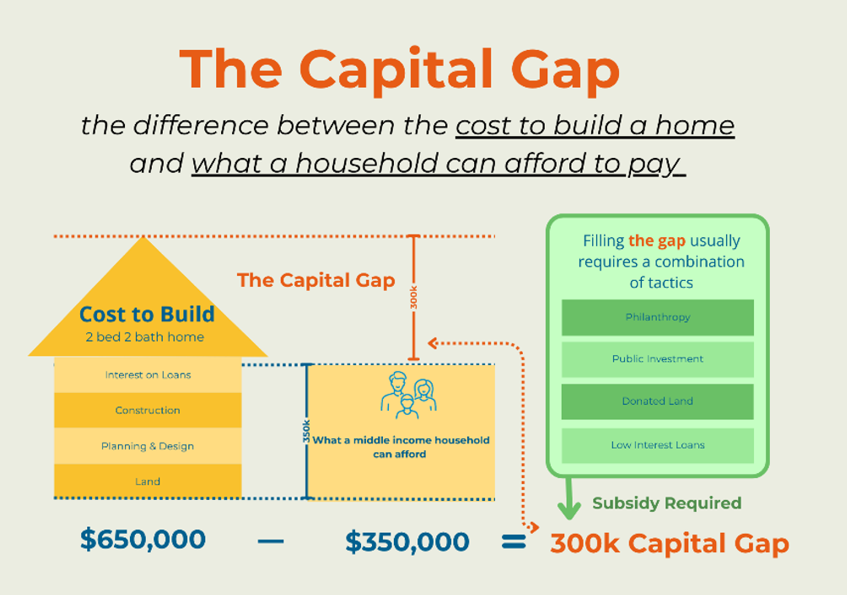
The gap varies across projects. A few factors can help narrow the gap, including building more densely (which spreads the cost of land across multiple homes), building smaller (less square footage means lower constructions costs) and building multiple homes at once (making use of economies of scale and shortening the development timeline for each home). While these efficiencies can certainly help, subsidy is still needed to make any below-market housing project mathematically and financially possible to build in the Gallatin Valley.
The capital gap clarifies that building affordable housing is not a question of morality or goodwill, but rather a math equation that requires subsidy. If a project doesn’t at least break even, it cannot be built without subsidy. Community investment is required to meet our needs across the spectrum of affordability.
But why did things get so expensive in the first place?
How did we get here?
Bozeman is a nice place to live
Bozeman is, and will hopefully remain, a desirable place to live: we all enjoy the benefits of living in such a vibrant and beautiful home. “Amenity rich communities” like Bozeman often struggle with high costs of living because we attract people who can afford to move and pay premium rents. It’s not a bad thing that people want to live here, but if we don’t account for it in our policies and planning, our more vulnerable neighbors are the ones who get squeezed.
During the pandemic, the impact of being an amenity rich community was particularly strong.
After years of underbuilding, our housing stock was not prepared for that rapid population growth. Renters competed for the limited homes, outbidding each other and driving rents up. Costs nearly doubled in just a few short years.
The Development Cycle
This boom and bust in development, and the subsequent rent spikes and concessions outcomes are not isolated events — and they didn’t start with the pandemic-era population growth. To understand what happened, and what’s likely to come next, it helps to understand the development cycle.

Phase 1: The Squeeze
When the demand grows faster than supply, eventually we reach a scarcity of homes. Scarcity allows property owners and developers to command higher rents for existing and new rental housing.
Phase 2: The Rush
Responding rapidly to the opportunity, developers build. With everyone trying to get their slice of cake, developers overshot the demand, resulting in an oversupply of new homes.
Phase 3: The Correction
Now there is more supply (in a certain price range) than tenants (of a certain budget). Landlords offer lower rent and concessions as they compete over the limited tenants. With more competition, less opportunity to capitalize, and even some project that no longer “pencil”, the pipeline of new homes slows. A slower pipeline means that the vacancy rate begins to decrease.
Phase 4: The Waiting Game
When the market is in the favor of renters, developers can wait out the cycle until projected rents (and profits) justify their costs and risk in building. Demand grows faster than supply, vacancy rates fall, and prices begin slowly rise.
Then the cycle repeats.
Right now, we think that Bozeman is in Phase 3 or 4. SterlingCRE projects that, if current absorption rates hold and the development pipeline remains slow, Bozeman could return to an undersupply market within 18-24 months – bringing us back to the start of the cycle and a return to rent increases.
Structural compounders:
When housing is treated primarily as a financial asset – which in the U.S. is less a choice than a structural reality, embedded in mortgage markets and federal policy – the incentives of the people who own and develop homes don’t always align with the needs of the people who live in them.
In the development cycle, this shows up most prominently during Phase 4 of the cycle – the waiting game. Landowners can generally afford to wait for the rents to start increasing and for the investors to finance new projects again. Renters, by contrast, rarely have the luxury of waiting. When rents ratchet up in Phase 1, renters may move further from work and community, double up with others, or absorb the cost – often making sacrifices in other elements of their budget.
Developers in the private market produce most of our housing stock and are essential to ensuring the supply of homes keeps pace with the demand. But the market on its own will always leave gaps where projects don’t “pencil out”. Addressing these needs requires tools that go beyond waiting for the next phase of the cycle: public investment in permanently affordable housing like community land trusts, co-ops, and resident-owned communities.
What We Can Do:
As a community, we should strive to minimize the extremity of the upswings and downswings of the development cycle.
Maintaining a steady supply of new homes for our growing community is critical to maintaining a stable and predictable – and ultimately more affordable – housing market.
Additionally, we need to invest resources in filling the gaps that the traditional housing market will not fill.
At a local level, there are a few things that each of us might be able to do to also contribute to the stabilization of our housing market.
- Renters: Now is the time to negotiate your rent. Ask for concessions, negotiate longer-term leases, and lock in terms. This doesn’t work for everyone’s situation, but if you’re seeing a lot of inventory in your price range, then you have leverage — keep an eye out for resources from us on this soon.
- Homeowners/ Landowners: If you’ve been considering building an ADU in your back yard, turning an unused room into a rental, or doing an “incremental infill” project on a large backyard, now is the time to do that. The decline in new construction means that there is less competition for construction labor, and the more homes we can bring online in 2027, the less volatile the next upswing will be. With the market potentially returning to undersupply within 18-24 months, units added today will matter. If you have an ADU that is sitting unused – consider renting it out!
- Resourced Community Members: Invest in solutions that go beyond traditional market forces. Consider donating to Headwaters to help us build homes that are permanently affordable for middle-income households.
- City Leaders: Continue support policies and resources that keep the pipeline of new homes active, including ways to simplify neighborhood scale community driven projects. Examples include like pre-approved designs for middle housing, and participating in community education programs to help local neighbors gain the skills and confidence in building smaller, but highly impactful project. Continue seeking opportunities to invest in new below-market housing like the Hidden Creek development.
- Voters: Truly meeting our housing needs requires funding. Support opportunities to vote for funding affordable housing opportunities.
A more affordable, stable, and vibrant community is possible!