
It was the summer of 2020, and my friend and I were looking for a place to rent together in Bozeman. I was no longer able to stay in my old place, and it was time to try my luck in the most brutal rental market we’ve had in a decade.
Our eyes strained after hours sifting through Zillow, Craigslist, Facebook Marketplace, and property management company listings. We were getting desperate after weeks of searching and spending hundreds of dollars on rental application fees only to be ghosted or told that someone else beat us to the punch.
My obsession with Facebook Marketplace saved us: moments after a 2-bed 1-bath apartment was listed, I was in my car on my way to meet the property manager.
It was a quaint place, walkable to campus, with new paint and appliances. Even though the rent was $350 more than the last place I was in, we immediately signed a lease. Frankly, after being at it for weeks, we didn’t have another choice.
Shortly after moving in, we noticed that our apartment lacked a smoke detector and fire extinguisher. The fridge was installed improperly, and the microwave quickly stopped working. Then, in the middle of winter, the heating broke. It stayed broken for the next two years.
Despite the unresolved maintenance requests, our rent increased every year, without conversation or forewarning. It was a hard lesson: it didn’t matter how unresponsive the property manager was, or how conditions were deteriorating. We didn’t have other choices, and the landlord knew that.
Things finally became untenable when the building became infested with mice. They lived in our oven, cabinets, and closets. Our dishware was constantly contaminated with mouse urine and we couldn’t cook without making the whole unit smell like a barn. We tried everything: we set out traps, made sure our kitchen and floors were spotless, and even tried spraying peppermint oil every night.
Our property manager said that mice were normal and nothing could be done. We were at our wit’s end.
Luckily, by the summer of 2024, things had changed. There were hundreds, if not thousands, of new rentals on the market, and the “no other choice” problem for renters like me was starting to change. Fed up with our place and finally empowered with other options, we moved into a cute spot that was close to Lindley Park and much cheaper. It was older, a little musky, and in a dark basement, but the landlords were nice, responsive, and local. It fit our needs and our budget. We loved it there.
Having choices meant that I was able to get into a cleaner, safer, and more affordable home. For one of my friends, having housing options meant that she finally was able to move into an apartment by herself. For another friend, it meant being able to escape an unsafe partnership. In every case, having choices means having the power to live in homes that better suit our needs and wants.
A few months ago, when perusing Marketplace, I saw that mousey apartment by the university listed for rent. I watched for weeks with satisfaction as it sat empty until the rent trickled back down to what it cost when we first moved in in 2020.
…
The housing market goes through cycles of oversupply and undersupply, and that influences who has leverage and who is forced to compromise. The experience I shared was in a moment when demand outweighed supply, and I was forced to accept a bad situation because I didn’t have a better option. But we are in a different moment right now. Supply has outpaced demand, meaning that many landlords have to compete for tenants, and Bozeman renters have more choice – which means more leverage – than they’ve had in years.
If tenants never know they have leverage, they will not use it, and landlords get away with keeping tenants paying higher rents than market should theoretically allow. This is the first time in a decade that tenants have a bit of a market advantage, so it’s important to state clearly: Bozeman renters, you may have some leverage right now to negotiate your rent down.
Why negotiate now?
We’ve seen in Bozeman how our current oversupply of homes has translated into lower rents. Look at a listing for a building with more than 10 vacant units, and you’ll see one of two (or perhaps both) things: a declining rent history, or a big move-in credit (usually 4-8 weeks free).
A property manager’s job is to keep the property occupied and in good condition and generating income for the property owner. When a unit is vacant, the property owner is stuck paying the costs to operate the unit (debt payments, property taxes, management fees, trash etc.) while losing out on potential income. This means that vacant units can be very expensive and need to be filled as soon as possible.
But those are empty homes – when it comes to renewing incumbent tenants, property managers aren’t inclined to be as generous – unless the tenants apply some pressure.
This window of opportunity for tenants will not last forever. In fact, the supply of homes has already begun to narrow, and we are predicted to be in an undersupply market in 18-24 months. With that, renters will have fewer choices, property managers will have no problem filling vacancies, and rents will likely start rising again.
Despite the decreases, the rents are still too high for the 47% of renters in the Gallatin Valley who pay more than a third of their income on rent. This is why it is so important to use the opportunity we have now to drive rents down before the market allows rents to rise once more.
Assessing your Leverage
What do we mean by leverage?
Your leverage to negotiate with your landlord is in your ability to not renew your lease and find another place to live (costing them money). They’ll want to keep you where you are, and they might offer some concessions to make that happen. This doesn’t mean that you must leave if you don’t get what you want – the important thing is that the property manager feels like you might. So, you’ll need to be able to make the argument that you have comparable rental options that would compel you to leave.
Even if rents broadly are trending down, not all renters have the same amount of leverage. There are more units available at certain price points than others. Researching what comparable units in your budget are going for, and how many of them are available, is key to understanding your power to negotiate.
Researching comparable rentals
The ideal comparison for negotiating would be an identical unit in your building. If you’re paying $1800 for the same unit that’s listed for $1700, you have a pretty easy case to make!
I was once out canvassing and knocked on the door of a renter in an apartment complex. He shared that he had just successfully negotiated his rent down because he saw the unit down the hall listed for $200 less than he was paying. Talking to your neighbors can be a great way to figure out if you or your neighbors might be overpaying.
When you don’t have an exact comparison, look for other available units similar to yours in bedroom/bathroom count, square footage, amenities, age, and location. If you want to understand all the variables your landlord considers when setting rents, check out this source: Rent Analysis Reports: Make Smarter Rental Decisions.
Start with websites like Zillow, RentCafe, or Apartments.com. Document what you find, taking special note of the rent price and any “concessions” the landlords are offering to fill vacant units.
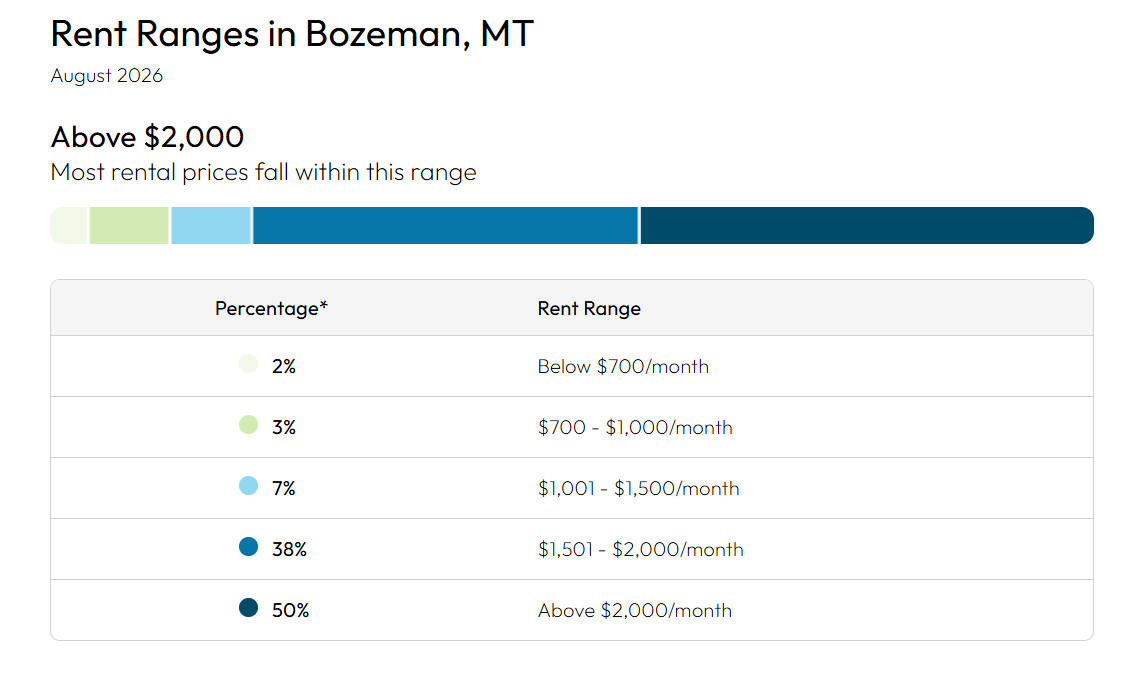
Based on current rent ranges, there are a lot of options for tenants paying more than $1,500/month, so if you’re in that budget range, you’ll have a good chance at having some considerable leverage.
If you find out that there aren’t any comparable options for you, and you as an individual don’t have a ton of leverage, you may be able to get more power if you band together with your neighbors. If you are curious about negotiating your lease with your neighbors, reach out to the Bozeman Tenants Union. They are the go-to folks for collective bargaining.
Consider the relationship you have with your property manager/landlord
Being in good standing with your property manager makes it more likely that they will be willing to make a deal with you. The opposite is also true: if you’ve been in conflict with your landlord, they might be less flexible to try to keep you.
When assessing your position, factor in any history of late payments, property damage, noise complaints, or non-compliance with the lease you may have. These wouldn’t mean that you shouldn’t try to negotiate – especially if you’ve done your homework and have a strong case to make – just don’t let it catch you off guard.
You want to try negotiating your rent. Where do you start?
After researching comparable rentals in the area and documenting what you find, consider timing. If you’re month-to-month, you can negotiate any time. If you’re on an annual lease, see if you can start a conversation with your landlord in the month or two before your term ends.
Spend some time considering what are the most important things for you in negotiations. Do you want to pay less monthly? Do you need your heater repaired or a professional to eradicate mice? Additionally, consider what you could offer that the landlord may want. Maybe you could sign a longer-term lease. Perhaps instead of lower rent, they will cover utilities.
Before you go to the negotiating table, spend some time thinking like your landlord. Imagine how they might respond to your requests and what would make them compelled to make a deal with you. This resource (designed to prepare landlords for negotiation) might help you get in the headspace.
Once you’ve decided what you want to ask for, you might reach out and say something like this: “I’ve enjoyed living here and working with you and your team, but I’m seeing similar units in this area going for $1600/mo, while we’ve been paying $1800/mo. We’d like to stay for another year, but at a rent that’s more consistent with what’s happening in the market. Could we agree to renew at $1600/mo?” Then you might be prepared to move on things like price or lease length to get to a deal. Keep things polite, professional, and direct.! And if you get a counteroffer, you can always ask for some time to think about it.
For a check-list style resource with lots of example language and pro-tips, check out this Step-by- step guide to negotiating your lease.
…
At the end of the day, it’s important to keep in mind that the rental market is always changing. Renters – even if they’re happy where they’re at – should know what’s happening in the market so that we can all work together to keep property managers honest and prices where they should be. Landlords and property management companies have a lot of tools, people, and a money directed at making sure they get the most out of their rental properties. While a far cry from leveling the playing field, we hope this blog helps tenants assess and negotiate with their landlords from a position of strength and confidence.
Don’t hesitate to reach out if you have questions and we can do our best to answer, and please, let us know if you negotiate your lease and how it goes.